

In the first four months of 2026, close to €4.9 billion in tax revenue was collected. This is €71.2 million more than during the same period last year. The largest contributors to the increase in revenue were value added tax (+€217.7 million), social tax (+€99 million), and fuel excise duty (+€26.5 million).
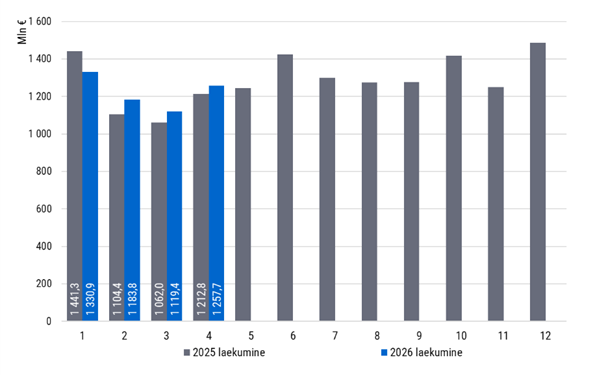
Graph: Tax receipts in the first four months of 2025 and 2026
VAT receipts in April amounted to over €364 million, which is €45.6 million more than in April last year. Raili Roosimaa, Deputy Director General for Taxes at the Estonian Tax and Customs Board, said that the rise in VAT revenue was driven primarily by the retail and wholesale sectors, particularly the retail and wholesale of motor fuels and motor vehicles.
“The same sectors have been driving strong tax revenue over the past few months. It is worth noting that VAT revenue collected under the special scheme for e-commerce and services increased by nearly a third year on year. This is due, among other things, to VAT paid on services purchased from tech giants as well as on goods bought from Asian e-commerce platforms,” Roosimaa noted.
The volume of low-value consignments arriving from third countries has skyrocketed in recent years. From 1 July 2026, a fixed customs duty will apply to low-value consignments worth less than €150 ordered from these countries.
Personal income tax revenue in April totalled over €216 million, which is €6 million less than in the same month last year. This was influenced by the change in the system for calculating basic exemption made at the beginning of the year. The wage fund grew by 5.7% year on year, increasing social tax revenue to €460 million – up by approximately €24.7 million from April last year.
Corporate income tax revenue in April exceeded €58 million, which is nearly €26 million less than a year ago, as fewer dividends than last year were paid out in the private sector.
Fuel excise duty revenue amounted to over €47.3 million in April, which is approximately €1 million less than in April of last year. In April last year, stockpiling occurred due to an increase in excise duty. Since the excise duty increase on energy carriers was cancelled this year, no stockpiling took place, and approximately 15 million litres less fuel was released for consumption than in April 2025. “However, in the first four months combined, more fuel was released for consumption than during the same period last year. This is due to higher demand compared with the first quarter of last year, driven by both cold weather and price factors,” explained Raili Roosimaa. According to her, fuel excise duty revenue has remained stable over the past few months.
Tobacco excise duty revenue in April was €22.5 million, or over €1 million less than in April last year. The decrease in revenue was due to approximately 23 million fewer cigarettes released for consumption in April 2026 than a year earlier. However, in this year’s April and during the first four months of the year, a slightly larger number of nicotine pouches were released for consumption than during the same periods last year. This indicates a shift in consumer preferences and has also increased excise duty revenue from solid tobacco substitute products.
Alcohol excise duty revenue in April was over €16 million – approximately €600,000 less than a year ago. The large-scale stockpiling of spirits and beer that took place at the end of 2025, ahead of the excise duty increase, still affects the quantities released for consumption.
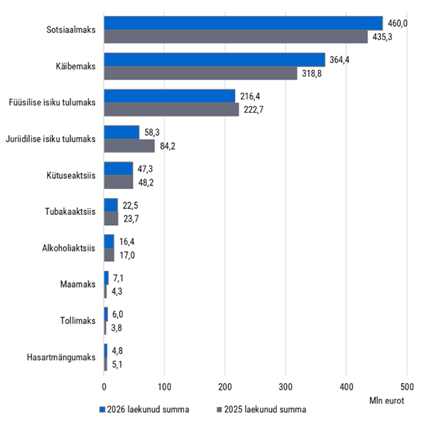
Graph: Tax receipts in April 2026 compared with April 2025 for selected taxes
As at 1 May 2026, total tax arrears amounted to €344.6 million, of which €49.7 million consisted of deferred tax arrears.
Tax arrears decreased by €8.2 million in April. The largest drops were seen in social tax arrears (€3.1 million), land tax arrears (€2.6 million), and withheld income tax arrears (€1.3 million).
In April, the bulk of the tax arrears was concentrated in the wholesale and retail trade, construction, and manufacturing sectors, where tax arrears consistently account for approximately half of the total debt balance. Most of the arrears in these sectors were related to VAT, special income tax, and labour taxes.
At the end of April, there were close to 59,900 persons with tax arrears. The number of debtors decreased by nearly 20,900 in April, mainly due to the payment of land tax obligations following the deadline at the end of March. The number of natural persons with tax arrears saw the largest decline. The number of natural persons with land tax arrears was down by 14,600 compared with the previous month, and the total debt balance decreased by €1.5 million. Among legal persons, the number of debtors fell by 4,700, and the total debt balance decreased by €1.1 million.
As at 1 May, close to 27,500 persons had unpaid land tax liabilities amounting to €2.7 million, and 11,400 persons had unpaid motor vehicle tax liabilities amounting to nearly €1.3 million. Tax arrears of natural persons are primarily related to land tax and motor vehicle tax, which affect a large proportion of taxpayers but account for only a small share of the total debt balance.
“A short-term rise in the number of debtors after the land tax deadline at the end of March is common. The data for April confirm that short-term arrears are paid or deferred quickly after the due date. Land tax arrears, like motor vehicle tax arrears, are mostly temporary in nature and related to delays in paying tax obligations, not widespread inability to pay,” Raili Roosimaa pointed out.
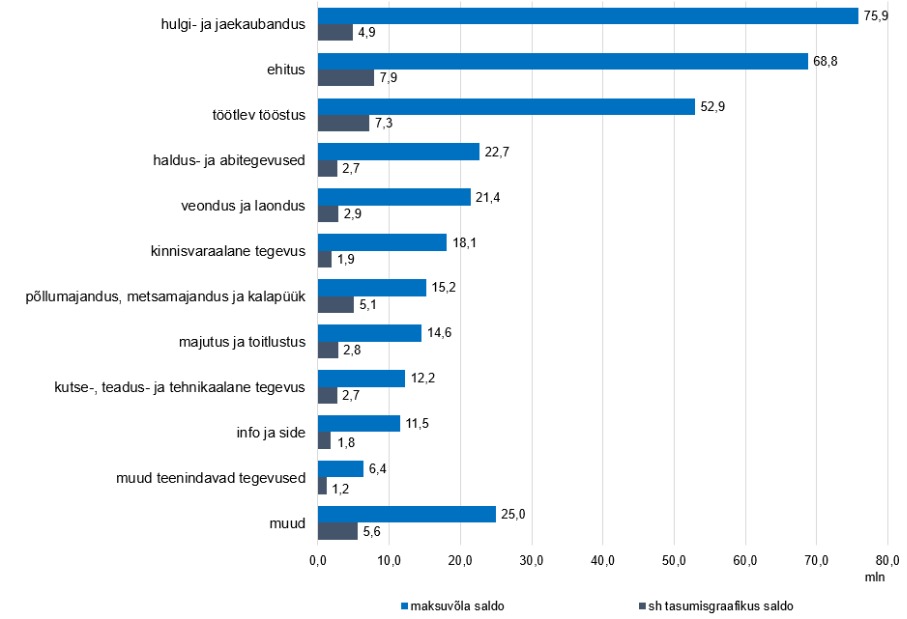
Graph: Tax debt balance by sector as at 1 May 2026
The Tax and Customs Board is available to assist taxpayers with fulfilling and deferring their tax obligations. If you have an outstanding tax liability, it is worth reviewing your options for paying it in the near future or, if necessary, arranging a payment plan. When deferring a liability, payments can be made in instalments over a period of 2 to 24 months, but interest will be added. The Tax and Customs Board is always happy to advise and work with taxpayers to find suitable solutions.
More information on the rescheduling of tax arrears for private customers and companies is available on the website of the Tax and Customs Board. Instructions and FAQs can also be accessed by logging into the e-services environment e-MTA and selecting “Payments of tax liabilities in instalments” in the Help center section.
Overview of tax receipts is available on the website of the Tax and Customs Board.

