

Compared to January of last year, tax revenue was slightly lower this year. The main reason is that an exceptionally large amount of corporate income tax was collected in January of last year. In January 2026, corporate income tax revenue was EUR 234 million lower than at the same time last year.
However, VAT revenue increased by nearly 20% in January compared to January of last year, i.e., by EUR 56.8 million.
According to Raili Roosimaa, Deputy Director General for Taxes at the Estonian Tax and Customs Board, VAT revenue in January was influenced by increased energy consumption and rising electricity and gas prices. ‘As a result, the energy sector made the largest contribution to the growth in VAT revenue in January. In addition, the obligation to pay VAT has increased significantly in retail and wholesale trade, and a cautious recovery in the wholesale and retail sale of motor vehicles is evident’.
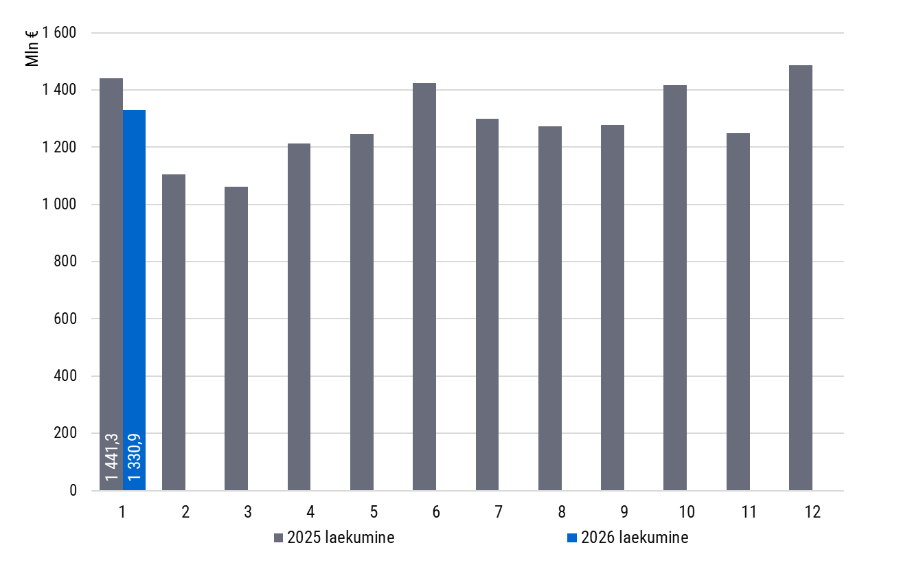
Table: Tax receipts in the first month of 2025 and 2026.
The growth in labour tax revenue seen last year continued into January of this year. Personal income tax revenue amounted to EUR 23 million, or 8.6% more than during the same period last year, and the social tax contribution was nearly EUR 30 million, or 7.5% more, with the main factors influencing this being the continued growth in the wage fund. It should be noted here that in January 2025, personal income tax was still collected at a rate of 20%.
Fuel excise duty revenue in January was EUR 9.5 million higher than in the same period last year, primarily driven by increased fuel consumption and sales volumes. However, revenue from alcohol and tobacco excise duties has decreased compared to a year ago.
Alcohol excise duty revenue was EUR 1.7 million less than in January 2025. A similar pattern has been observed for several consecutive years, where stockpiling of alcohol in warehouses increases at the end of the year ahead of excise duty rate hikes, and the release of excise goods for consumption is lower at the beginning of the year. More alcohol was also stockpiled at the end of 2025 than in the previous year, which is why less alcohol was released for consumption in January 2026 than during the same time last year.
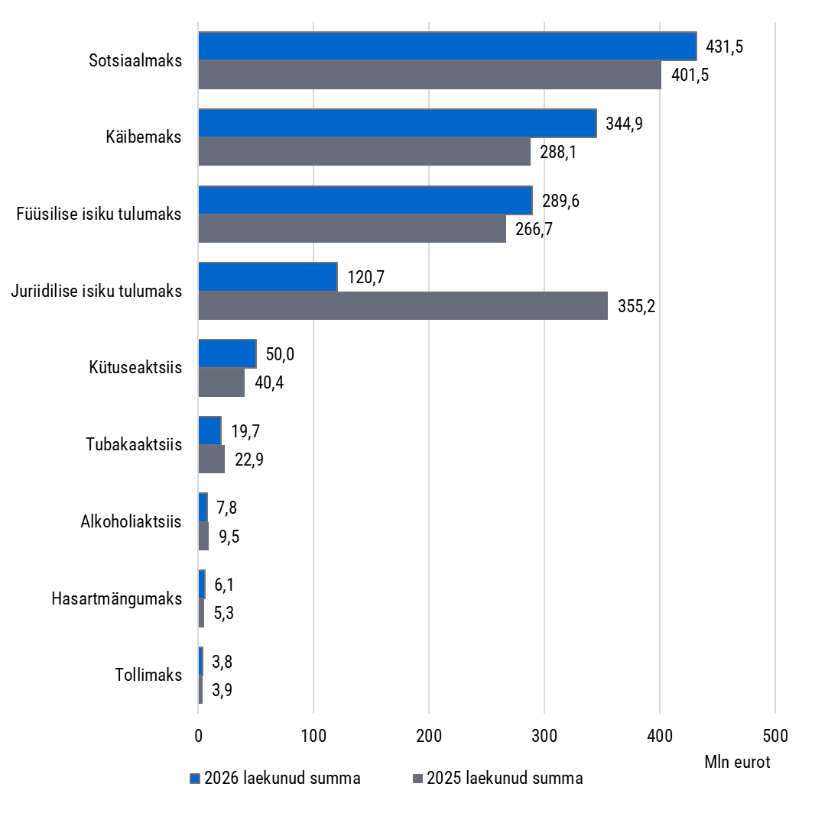
Table: tax revenue in January 2026 compared with January 2025 for selected taxes.
As at 1 February 2026, total tax arrears amounted to EUR 353.9 million, of which EUR 54.7 million consisted of deferred tax arrears.
In January, tax arrears fell by EUR 13.6 million, primarily due to reductions in social tax contributions and VAT, as well as income tax in special cases and motor vehicle tax arrears. As at the end of January, the highest levels of tax arrears were in the construction sector, wholesale and retail trade, the repair of motor vehicles and motorcycles, as well as the manufacturing industry.
In addition to tax receipts, the reduction in tax arrears was also influenced by the write-off of tax debts due to expiry. In January, the ETCB wrote off a total of EUR 21.2 million in tax arrears due to expiry, which is standard practice at the start of a year.
The number of persons with tax arrears fell by 18,600 during January, of whom 16,800 were natural persons. The decrease in the number of debtors was mainly influenced by the payment of motor vehicle tax, the deadline for which fell at the end of December and the beginning of January.
‘At the beginning of January, the number of debtors doubled, primarily due to the arrival of motor vehicle tax deadlines. Over the course of the month, the number of debtors in this tax category decreased by more than 17,500 people and the amount of debt by EUR 1.9 million. This confirms the usual pattern that immediately after the payment deadline, the number of debtors often increases temporarily, but later the tax is paid or a payment plan is agreed upon,’ said Raili Roosimaa. ‘Tax discipline in Estonia remains at a good level and improved slightly in January. Nearly 89% of all tax claims are paid on time’.
Information on tax deferrals for private individuals and businesses can be found on the ETCB website. Guides and frequently asked questions can also be accessed by logging into the e-ETCB e-services portal and selecting ‘Tax deferral’ under the Help Centre section.
Reade the overview on tax collection on the ETCB website.

